Judges tested DirectCase: 75% of users found relevant case law within two queries.
The Centre for Digitalisation and Artificial Intelligence in Justice (CendAI) examined how technology can support the efficiency of legal research. The result: 50 minutes saved per research task.
"The experience with DirectCase showed how technology can contribute to more efficient case-law research. The CendAI project, in cooperation with judges and assistants of the Prague High Court, allowed us to verify the benefit in a real court environment."
— Roman Horáček, Ph.D., founder of CendAI and Vice-President for Civil Matters at the Prague High Court, November 2025
Judges and assistants of the Prague High Court took part in a pilot test of DirectCase, a tool that uses artificial intelligence for faster and more accurate case-law research. The goal of the CendAI project was to verify whether AI can really help in an environment where accuracy and trustworthiness are critical.
CendAI brings technology-based innovation to Czech justice
The Centre for Digitalisation and Artificial Intelligence in Justice (CendAI) was established with the mission of supporting the considered adoption of modern technologies into judicial practice. Its goal is to ensure that digitalisation is not an end in itself, but genuinely makes court processes more efficient, develops judicial education, and at the same time respects the ethical and legal aspects of AI use.
Under the auspices of CendAI, a pilot project of DirectCase took place at the Prague High Court. The aim was to verify how current AI methods can speed up legal research and improve accuracy in finding relevant information without compromising the quality of professional assessment.
The Prague High Court: can DirectCase stand up to a highly skilled audience?
The court environment is by its nature conservative, and rightly so. Stability and a focus on accuracy are core values for the judiciary. Previous experience with the accuracy of similar tools led to some caution when starting the tests. Of the judges and assistants approached, twelve took part in testing DirectCase.
Each participant used DirectCase for real case-law research for two months and evaluated its benefit in terms of relevance of the judgments found, trustworthiness of citations, time savings, and user comfort.
75% of users rated the judgments found as relevant
According to the pilot project evaluation, participants described improvements in both the speed and accuracy of research. Despite initial scepticism about the accuracy of answers, the pilot showed that the technology can find relevant judgments, either on the first query (33%) or after subsequent interaction with the tool (42%).
"It primarily works with a closed database of court decisions. The influence of false citations from open sources is limited."
— A participant evaluating the functionality of DirectCase in the pilot report
An important element of the system is analysis over the complete database of published judgments from all courts in the Czech Republic. This is a significant difference compared to common generative AI tools such as ChatGPT or Copilot.
A key element determining the usability of such a system in legal practice is the verifiability of every piece of information. Every output includes a direct citation and a link to the original text of the decision, which the user can reach easily. This transparency ensures that the final decision always remains in the hands of the human, with full control over source and interpretation.
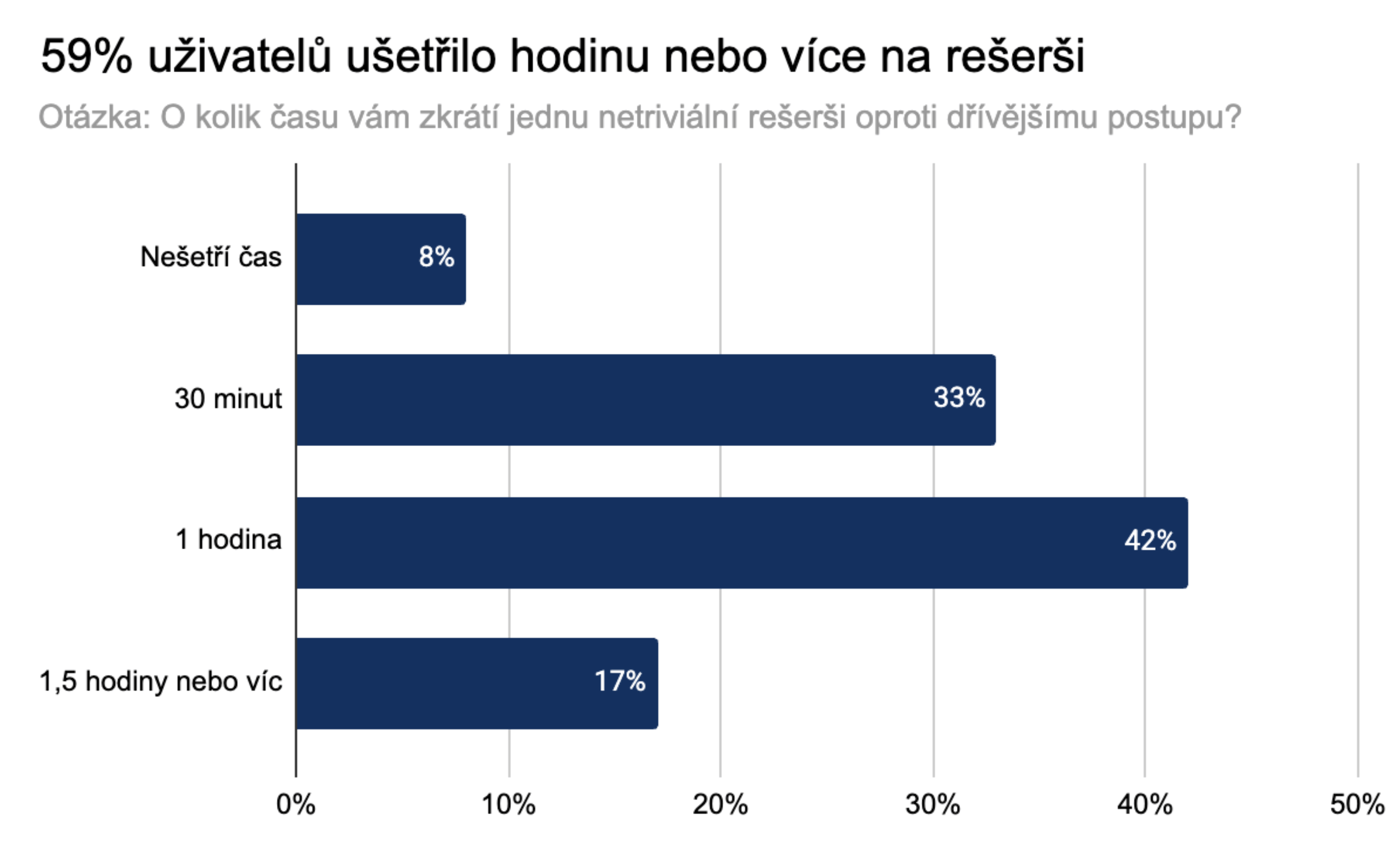
50 minutes saved per research task
On average, DirectCase saved up to 50 minutes per non-trivial research task. Depending on case variability and the number of research tasks, this can represent as much as one saved working day per month in practice. That is the main benefit of the system: removing routine, mechanical search work and allowing users to quickly obtain relevant judgments in their original wording. The judge can then focus more on the quality of the final output.
What drives this time saving? DirectCase does not only search for keywords — it finds information by the entire given context. The principle is illustrated, for example, by the question: "How is the local jurisdiction of the court determined if the contract specifies the creditor's bank account as the place of performance, but that account does not exist?" Traditional research is very demanding in such a case. Keywords are too general, and for commentaries on statutes the question is too specific. DirectCase, thanks to its understanding of context, is able to find the matching case law within one minute.
"Some participants would like to continue using the system even after the pilot ends; they see a practical benefit for everyday work."
— JUDr. Kateřina Procházková, assistant to the chamber's presiding judge, who participated in organising and coordinating the tool's testing.
DirectCase evolves continuously based on user feedback
One of the most frequent points raised by judges and assistants of the Prague High Court was the need for a continuous chat thread. Users want space for deeper, contextually connected work with a query. The DirectCase team has added this functionality to the development roadmap for the fourth quarter of 2025.
The pilot test confirmed that AI technology can support the efficiency of legal research, provided that source transparency and verifiability are ensured. The project also showed that innovation in justice can work if it respects its core values: accuracy, stability, and responsibility.
This case study was created as part of pilot research on the potential use of artificial intelligence in working with legal information. The findings and experiences presented here come from a specific pilot project and should not be interpreted as an official position of the Prague High Court.
Liked this article? Share it.