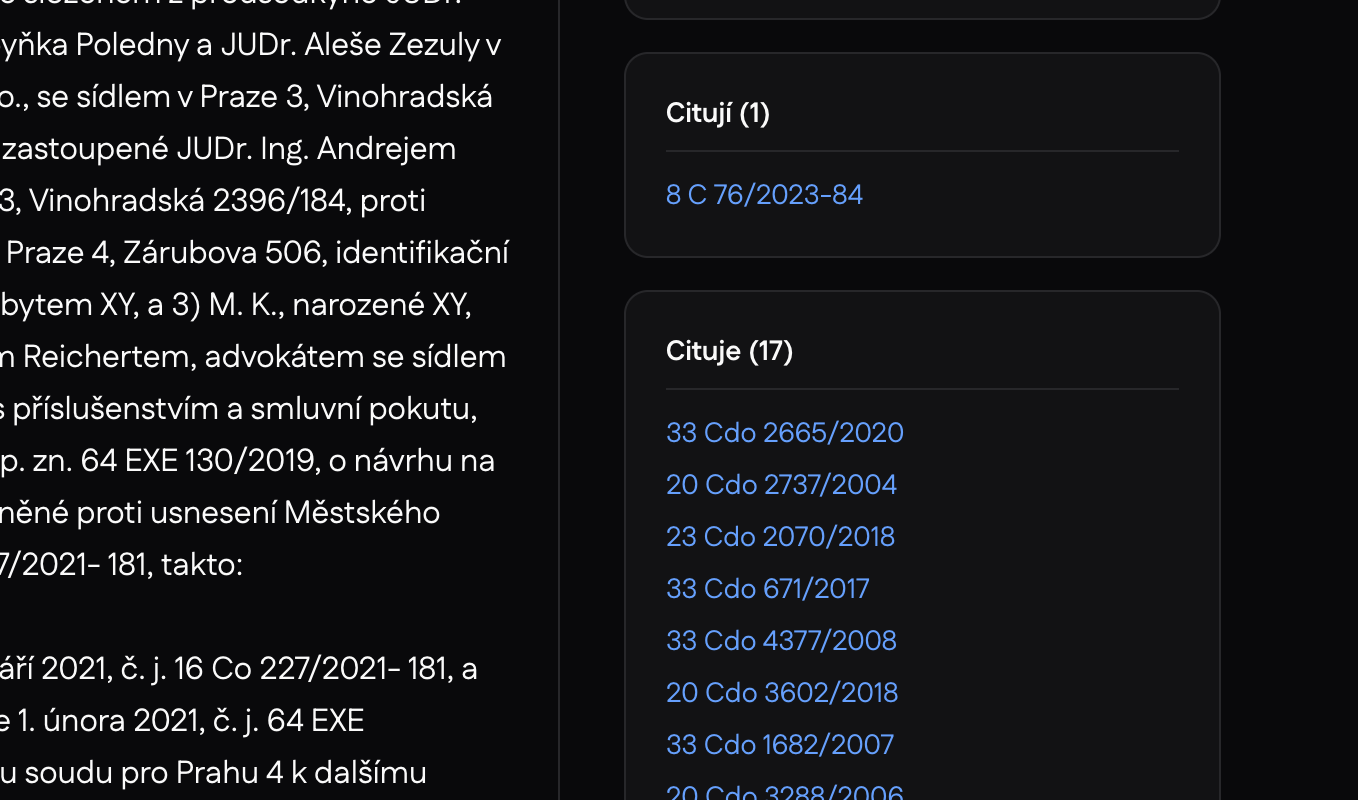
Case-law map: which decision cites a specific judgment?
Navigating case law often means tens of minutes to hours of manual lookup. But if you need to find out which decision cites a specific court judgment, you don't have to trudge through individual databases.
Navigating case law often means tens of minutes to hours of manual lookup. But if you need to find out which decision cites a specific court judgment, you don't have to trudge through individual databases.
Within the DirectCase.ai platform we've built a complete citation map of Czech case law that makes it possible to display the relationships between individual decisions quickly and clearly.
What does the map contain?
We've analyzed judgments across the judiciary, including:
- Constitutional Court
- Supreme Court
- Supreme Administrative Court
- district courts
The result is an interconnected network of decisions that captures:
- who cites whom
- how often a particular ruling is used
- which judgments form key precedential nodes
- how legal views evolve over time
How does it work?
Each decision is analyzed by AI agents that:
- Identify citations of other court decisions
- Recognize the citation context (supporting argument, distinguishing, criticism)
- Create structured links between documents
- Place the decision in the overall citation network
The result is a visual and data map of connections that lets you immediately grasp the significance of a specific ruling in a broader context.
Why it matters
Seeing citation relationships brings fundamental advantages:
- fast identification of authoritative decisions
- uncovering settled decision-making practice
- finding related cases in seconds
- strategic preparation of arguments
Instead of reading a single ruling in isolation, you get the context of the whole decision network.
A complete map of case law
By building this map we've linked decisions across instances and levels of the court system. The result is a data infrastructure that enables not only search but also deep analysis of how legal views develop.
Mapping case law represents a new approach to working with legal information — moving from linear searching to a networked understanding of connections.
Liked this article? Share it.