Citations of court decisions: a new feature
Find out which court decisions are still relevant. The new DirectCase feature color-codes citations by their currency and legal weight.
Find out which court decisions are still relevant. The new DirectCase feature color-codes citations by their currency and legal weight.
Legal research has one unpleasant quality — it isn't enough to find a decision that relates to your case. You need to know whether courts still cite it, whether they affirm it, or whether more recent case law has quietly abandoned it. Until now you had to work this out by hand. From now on our application does it for you.
What the new feature does
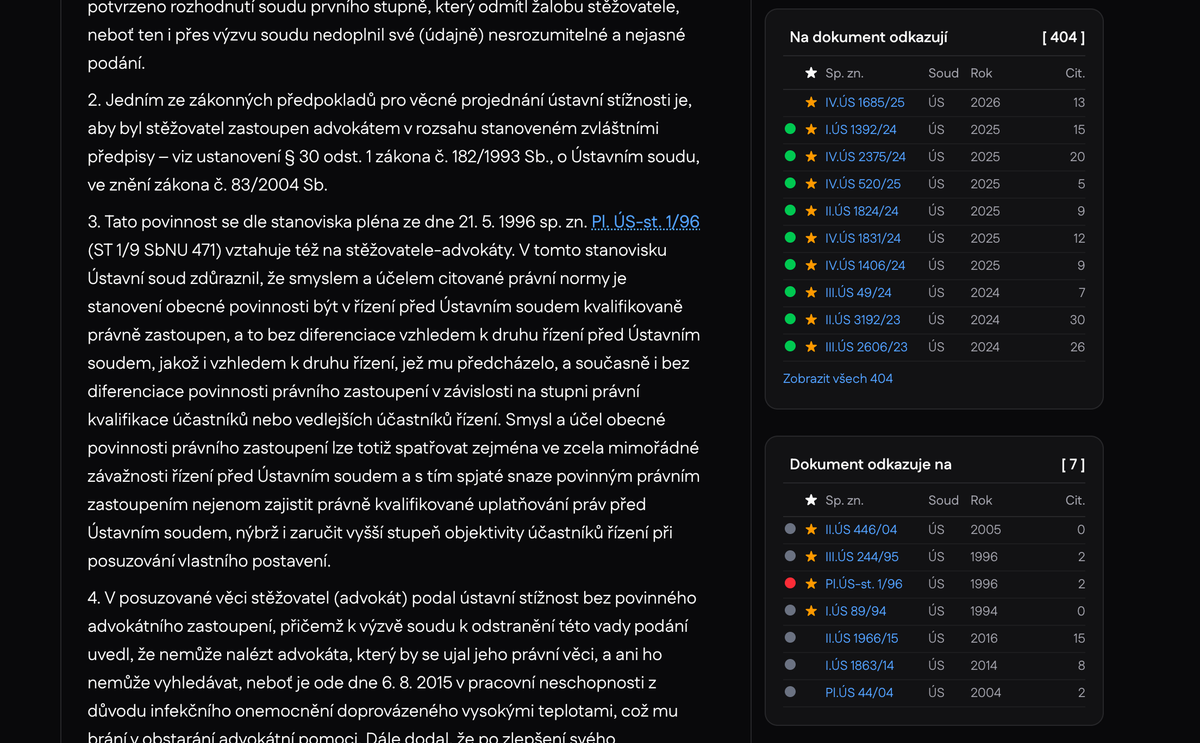
For every decision you now see two things: which documents cite it, and which documents it cites. This isn't just a list — each link is color-coded based on what the citation actually means.
Green means the court cites the decision favorably and continues its practice. The decision is live and usable as an argument.
Gray means the citation is ambiguous — either a party is relying on it, or it isn't clear from the context whether the court adopts the practice.
Red is a warning sign: the decision has been overturned, changed, or case law has moved in a different direction. Before using it in a filing or analysis, verify it in detail.
A star for key decisions
Decisions of exceptional weight in the legal system deserve special attention — plenary opinions of the Constitutional Court, decisions of the Grand Chamber of the Supreme Court, and decisions of the Extended Panel of the Supreme Administrative Court. These decisions are marked with a star in citations so you can recognize them immediately.
Why it matters
The citation network of court decisions reflects how the law actually evolves. The color coding gives you an instant overview of the state of case law without having to read dozens of decisions just to find out whether an older one is still relevant.
The rating is performed by AI based on an analysis of the citation context. As with any tool, we recommend verifying red-flagged decisions yourself — that's precisely what the red color invites you to do.
Liked this article? Share it.